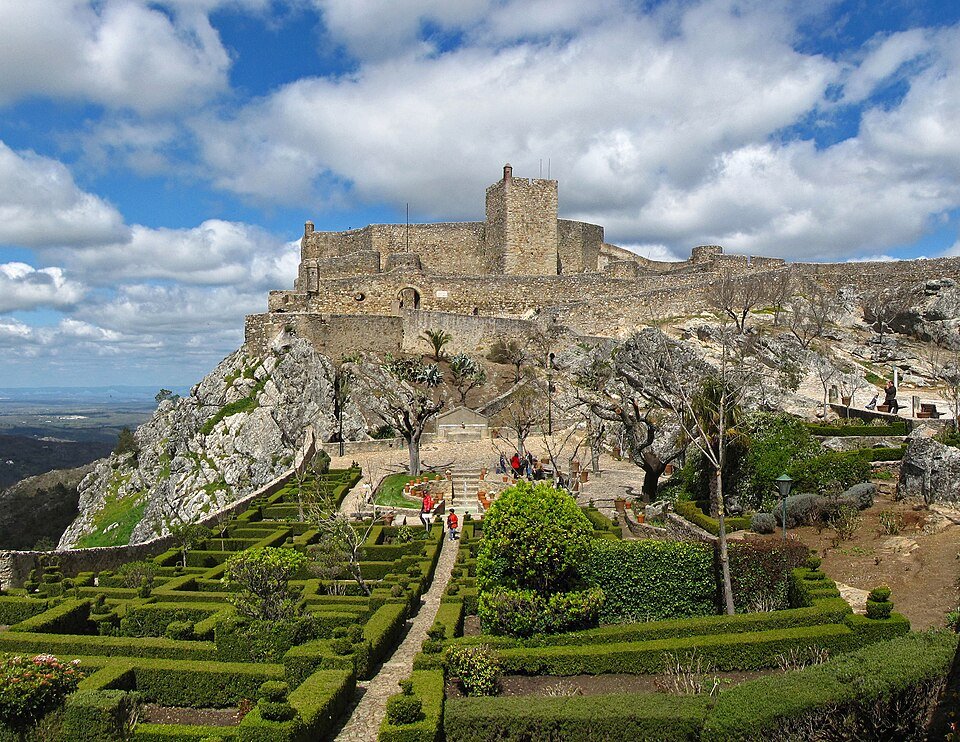
A walled village, a vast horizon and time to look.
Marvão sits high above the surrounding countryside, with whitewashed lanes inside its walls. The castle provides the dramatic arrival, but an overnight stay lets you enjoy the village after the busiest part of the day has passed.
Marvão is a fortified settlement whose topography does much of the storytelling. Its narrow ridge allows views across the surrounding Alentejo towards Spain, while walls gather houses and churches into a compact enclosure. Down in the valley, Roman Ammaia introduces a different model of settlement, with civic buildings and infrastructure spread over more accommodating ground.
Suggested stay: 2 nights. Adapt the pace to your interests.
Explore the fortress setting and the long views. Walls and exposed edges are not playgrounds, keep to safe visitor routes and check access notices.
The castle occupies the commanding end of Marvão’s rocky ridge, where natural stone and constructed defences reinforce one another. Walls, towers and enclosed spaces reveal the importance of controlling this elevated border landscape. From within the fortifications, the tightly grouped village and the broad countryside make the defensive choice of site easy to understand.
Walk the little streets, gates and white façades at an unhurried pace. Comfortable shoes matter more than the short distances suggest.
The village’s whitewashed buildings fit closely between its protective walls and the rising rock. Narrow passages, steps and framed stone openings keep changing the view, while churches and small civic spaces interrupt the domestic scale. Looking back from an open stretch of wall reveals how little separation there is between settlement and fortification.
The museum in the former Santa Maria church offers a compact local-history chapter. Check current opening arrangements before making a special visit.
The municipal museum occupies the former church of Santa Maria, preserving the religious building as part of the display’s setting. Archaeology, sacred art and ethnographic material connect the municipality’s long history with more recent local life. It gives the ridge-top settlement a context that the castle’s military architecture alone cannot provide.
Add the archaeological site in the valley as a separate road outing. It is not inside Marvão’s hilltop walls, arrange transport and check the museum’s visitor details.
Ammaia developed as a Roman town in Lusitania during the first century AD. Excavated remains include the South Gate, public baths and parts of the forum, showing a civic settlement quite different from medieval Marvão above. The site museum presents finds from the excavations, linking small objects with the larger urban plan.
Reserve village accommodation and dinner when your dates are fixed. If visiting Ammaia, confirm its own opening and ticket arrangements separately.
With children & at your own pace
The village rewards a short explorer’s walk, but supervise around walls and steep edges. Break the visit with a square or garden rather than long exposed wall sections.
Access & getting around comfortably
Historic paving, steps and gradients vary street by street. Ask for room access and a suitable route in advance, the castle has different challenges from the village core.
Season & conditions
The hilltop can feel windy even when the valley is warm. Summer afternoons can be hot, spring and autumn allow more comfortable wandering.
Eat & drink
A LOCAL DINING OPTION
Pousada de Marvão restaurant
A village hotel restaurant for a planned Alentejo meal. Ask about the current menu and non-resident reservations.
Fewer than 15 rooms? Contact the hotel directly. 15 rooms or more?Ask ATA for low group rates → We use existing agreements where available and negotiate for your group when needed. We respond within 48 hours, allowing for worldwide time zones.
Getting here & local help
Plan the last part too
Plan a road transfer to the hilltop village and ask your hotel about parking outside or within the permitted area. A regional place name on a timetable does not guarantee arrival at the castle gate.
Use the official resource below for local information, current visitor arrangements and tourism contacts. For a specific attraction or booking, contact its operator directly.
Written for ATA, published October 25, 2026. Official resources are linked beside the subjects they support. A live source link is not a guarantee that conditions will remain unchanged.