Journey Through Time: The History of Nova Scotia
Nova Scotia, Canada's Ocean Playground, holds a rich history that blends
indigenous heritage, European exploration, and a complex evolution that has
shaped the province's distinct cultural fabric. Nestled on Canada's eastern
shore, Nova Scotia's tale is written in the forests of its highlands, along its
rugged coastline, and in its bustling port cities.
The Mi'kmaq people, the indigenous inhabitants of Nova Scotia, hold an enduring
connection to this land, predating European arrival by thousands of years. Their
vibrant culture, shaped by the rhythms of the seasons and the sea, continues to
resonate throughout Nova Scotia.
The narrative of Nova Scotia shifted dramatically with the arrival of European
explorers in the 15th and 16th centuries. John Cabot, an Italian explorer
sailing under the English flag, is believed to have landed on the shores of Cape
Breton Island in 1497. However, it was the French who established the first
permanent European settlement in 1605, Port Royal, known today as Annapolis
Royal.
The 17th and 18th centuries were marked by rivalries and conflicts as the French
and British vied for control of Nova Scotia. The Acadian Expulsion (1755-1763)
was a tragic chapter during this period, as the British forcibly removed
thousands of French-speaking Acadians who had refused to pledge allegiance to
the British Crown.
The late 18th century saw an influx of Loyalists, fleeing the American
Revolution, which further altered the province's demographic makeup. The early
19th century brought waves of immigrants from Scotland, significantly
influencing Nova Scotia's culture, especially in regions like Cape Breton
Island.
Throughout the 19th and 20th centuries, Nova Scotia's economy was closely tied
to the sea, with industries like shipbuilding, fishing, and later, offshore oil
and gas playing key roles. The province also developed a robust mining industry,
particularly coal in Cape Breton and gypsum and salt in the mainland.
The modern era has seen Nova Scotia adapt to a changing economy, shifting from
resource-based industries to a greater focus on services, including healthcare,
education, and tourism. The capital city of Halifax is known for its thriving
arts scene, its naval base, and for its universities, drawing students from
around the world.
Today, Nova Scotia stands as a testament to resilience, diversity, and a deep
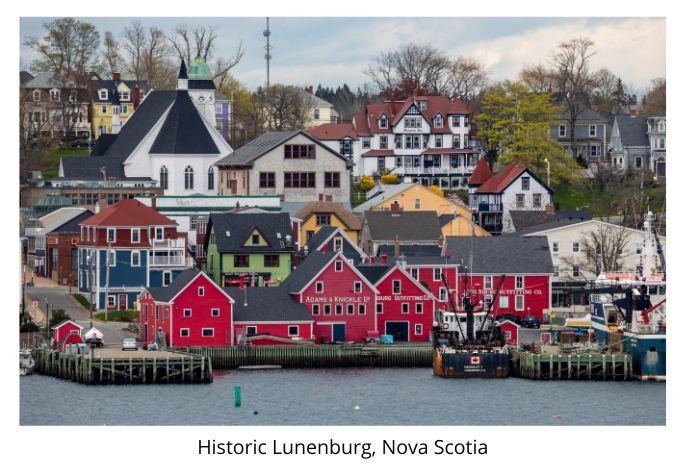
connection to the sea. It is a place where past and present intersect, from the
UNESCO World Heritage Site of Lunenburg, an impeccably preserved British
colonial town, to the historic Pier 21 in Halifax, the gateway for over a
million immigrants to Canada.
The history of Nova Scotia, much like the roll of the Atlantic waves against its
rocky shores or the haunting tune of a fiddle in a Cape Breton pub, is a
testament to the enduring spirit of the place and its people. The past has
shaped its present, and as the narrative continues to unfold, it will
undoubtedly guide its future.
Image: Sailing ship.
Text: "Nova Scotia - Canada's Ocean Playground".
In the top half there is a blue diagonal cross. Where the diagonals meet there is a small yellow shield with a red lion.
The bottom half has a blue shield with the road number.
Home | States/Provinces | Subjects
